
Florence County Property Value Types
Any Florence County property value search follows one of three evidence paths. The municipal assessor sets an assessed value, which is a tax record. Wisconsin DOR calculates an equalized value for district comparison. Sale evidence lives in the recorded conveyance. The deed does not always show a plain price field. Before comparing amounts, write down the source and the land description. Also note the year or transaction date behind each number.
| Value | What It Is | Where |
|---|---|---|
| Assessed value | Local value used for property taxation; verify the current field and year. | Municipal assessor; county parcel portal may display tax data. |
| Equalized value | Statewide measure used to compare taxation districts. | Wisconsin Department of Revenue reports. |
| Market / appraised value | A sale-oriented estimate or licensed appraisal, not guaranteed by the tax card. | Licensed appraiser or relevant market evidence. |
| Last sale price | Amount paid in a particular conveyance, if reliably reported. | Recorded deed and transfer-fee evidence; exemptions can apply. |
An assessed value is not a promise of a sale price. An equalized value is not a quote for one parcel. A deed's transfer fee can sometimes hint at consideration. But the county notes the fee appears on most conveyances, not all. Any property value answer should name its measure. Treating "value" as one universal number invites errors a careful reader can avoid.
Florence County's 17.84% Equalized Trend
Wisconsin DOR's 2025 final equalized-value report shows Florence County's equalized value up 17.84%. That is a countywide indicator, not evidence that every parcel rose by the same amount. DOR explains that equalized value is based on market and new-construction data, is certified as of January 1, and helps compare taxation districts. Use it to understand the county trend, not to set a purchase offer or replace a parcel assessment.
The DOR's fall/winter 2025 explanation discusses the five-year and 10% compliance rule for assessment levels. That state-level rule is part of assessment oversight, not a cap on a home's market price. The parcel's local assessed value still comes from the municipal assessor.
The 17.84% increase is most useful as county context when tracking broad change across a tax district. It cannot be applied as a multiplier to an individual parcel, because assessment decisions and transaction evidence concern a particular property and period. A buyer comparing two parcels should compare their assessment years, legal descriptions, recorded sales, and taxing districts rather than assign each the countywide percentage change.
Florence County Assessed and Equalized Values
Assessed value attaches to a parcel through local assessment. Equalized value is calculated and certified at the state level for comparing taxing districts. The tax bill then applies local rates and district charges to the assessed record. These numbers move on different schedules and answer different questions. The county's Public Portal provides guest access to tax parcel data. It publishes no documented list of its parcel-card labels. Read the assessed, land, improvement, exemption, and history headings on the live card. They appear exactly as shown there.
- Assessed value
- The municipal assessment amount used in the local property-tax record.
- Equalized value
- A Wisconsin DOR comparison measure for a taxation district.
- Sale price
- Consideration in a specific transaction, if directly documented.
- Assessment ratio
- A comparison of assessed values with market-level measures in an assessment district.
- Reassessment
- A local update to assessed values; ask the municipal assessor about the current schedule.
When comparing value records, write down both the date of the source and the period it represents. Wisconsin DOR's equalized value is certified as of January 1 and supports comparison across districts; a local assessment is administered for the parcel by its municipal assessor. The tax bill then applies the relevant rates and district charges. These figures can be correct for different purposes while appearing inconsistent when their years and definitions are omitted.
Look Up a Florence County Property Value
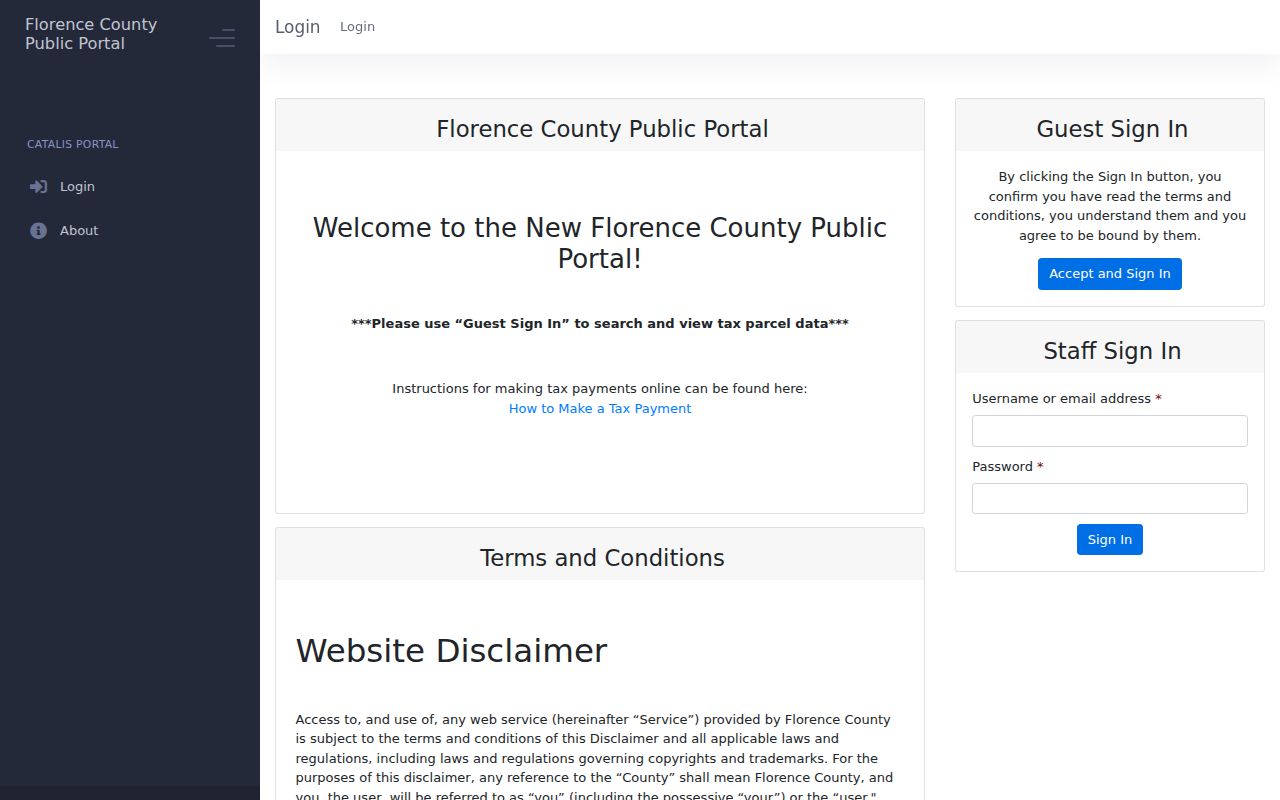
The Public Portal landing screen offers Guest Sign In for tax parcel data. Read the live value heading, tax year, and parcel description rather than assuming any field means assessed or market value. If a number stays unclear, ask the municipal assessor who serves the parcel. The Treasurer handles payments and tax balance questions. Assessment reasoning belongs to the assessor, not the Treasurer.
- Enter through Guest Sign In on the Florence County Public Portal.
- Match the address to the parcel number and legal description.
- Read the value field exactly as labeled and note its tax year.
- Ask the municipal assessor about the method, comparable evidence, or review steps.
- Use recorded deed evidence for a specific sale, while checking any transfer-fee caveat.
- Assessed value
- The local parcel value used for tax purposes.
- Market value
- A sale-oriented estimate that can differ from an assessment.
- Assessment ratio
- A measure comparing local assessed levels with a market benchmark.
- Consideration
- Value exchanged in a recorded transaction; it may not be displayed as a simple price.
Florence County Public Value Record
The county's Public Portal is the public starting point for tax parcel data. Its parcel values appear inside an interactive guest session rather than a static preview. Use the portal to reach the live search. Then confirm the value field and tax year with the assessor. Never quote a number from a frozen screen or assume it is market value.
After guest sign-in, open the Florence County parcel search. The parcel description matters as much as the value field. It confirms the result belongs to the property in question, not a neighbor's parcel.
An assessed value that needs review belongs with the municipal assessor. The county publishes no single appeal calendar or form covering every Florence municipality. Check with the local office for its process.
A portal number should never land in a listing. It should not appear in a valuation report as a current market quote. The Public Portal does not document its exact value labels. It does not document the land and improvement split, exemption display, or history fields. Confirm the live wording and tax year. Ask the assessor what a figure represents before comparing parcels. If a sale is the reference point, use the recorded instrument and its transaction date. Remember that a transfer fee can support, but does not always prove, sale consideration.
Florence County Deed Sale Evidence
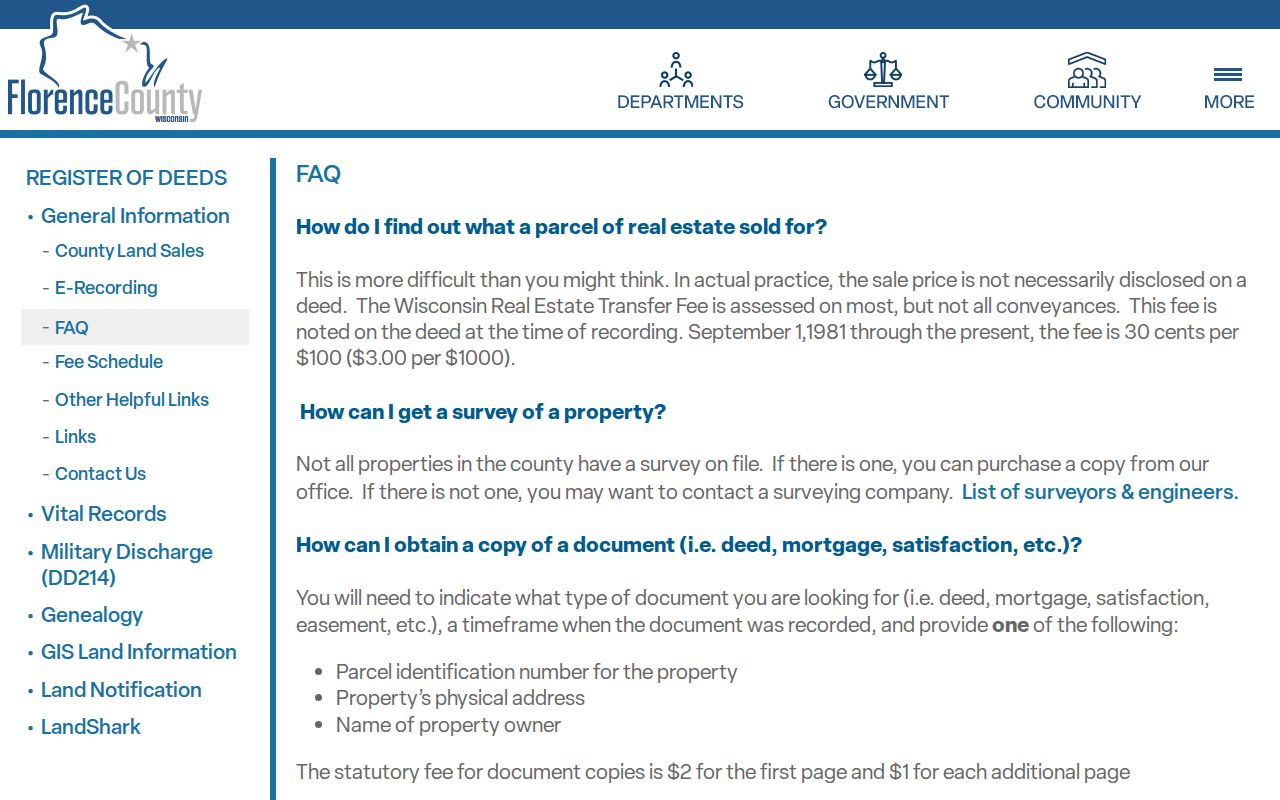
A recorded deed in Florence County rarely lists sale price as its own field. The Register of Deeds FAQ notes that Wisconsin's real estate transfer fee appears on most conveyances. Not every conveyance carries it, though. Conveyances recorded from September 1, 1981 forward state a fee of 30 cents per $100. Where that fee applies, you can work backward toward a transaction amount. Exempt transfers break the math. The fee never guarantees what a property actually sold for. Read the instrument itself and its consideration language before trusting any figure.
Treat deed sale evidence as a dated reference point. It is no substitute for a current appraisal.
Florence County Local and State Data
Timing explains most mismatches between statewide and local data. Wisconsin's statewide parcel release pulled county polygons in the first half of 2026. Most downloadable tax rolls date to 2025, though. So a statewide mirror can trail what the county itself posts. Start with Florence County GIS and the local Public Portal for parcel context. Turn to DOR equalized-value reports when comparing districts. The statewide map suits a broad study. Neither it nor local GIS amounts to a market valuation. For any property value question, log the source and vintage beside each number. A 2025 tax roll never matches a 2026 map. A deed sale date and a DOR report never form one synchronized figure either.
Limits of a Florence County Property Value
An assessed value is a tax record. It is not a signed appraisal for a sale, loan, or other transaction. It can diverge from current market evidence. The static material does not spell out the tax portal's exact value-history fields. GIS places a parcel on the map but will not price it. Likewise, the DOR's countywide equalized trend is no parcel-by-parcel result. Ask the local assessor about the assessment. Ask a licensed appraiser for a property-specific market opinion.
Value vs price. Florence County assessed value is used for tax purposes and is not a prediction of the sale price. A specific market opinion requires a qualified appraisal.