
Start a Florence County Property Search
Florence County property records live in several places, so the order of a search matters. Start with an address if you have one. The tax parcel result or the GIS map will hand you a parcel number and a legal description, and those keys stay stable long after owner names change. Use them in the deed index next. A name helps when an address is missing, or when one person or company holds several tracts. Names collide, though. The county search form handles that by letting you pick a grantor or grantee role and choose company, human, or both.
Treat any tax parcel result as a lead. It is not a title opinion. The map line is not a survey either. A freshly recorded deed can outrun the tax roll, so compare the parcel description against the newest deed and call the custodian when sources disagree. The Florence County property search workflow walks through the steps for an address, owner, or parcel lookup.
- Search the Florence County Public Portal or Colligo GIS with the site address, then note the parcel number and legal description.
- Search the Register of Deeds by grantor, grantee, instrument category, or property description to find the recorded document.
- Use the county tax portal for tax parcel data and payment status, and ask the municipal assessor about an assessment question.
- Use county GIS to view parcel geometry and map context. Do not treat the line as a legal boundary.
- Request an office copy or an older book reference when an image is not online; give the office the owner, parcel, address, document type, and date range.
Florence County Property Records Offices
Most county land-record offices share one courthouse building. Each keeps a different set of documents. The Register of Deeds records and indexes instruments. The Treasurer also serves as Property Lister and Land Information Officer. Municipal assessors handle assessments. The Clerk of Circuit Court holds files. These can explain probate, foreclosure, judgments, or title disputes behind a later deed. Call ahead if your request depends on a file that is not online.
Florence County Register of Deeds
501 Lake Avenue, P.O. Box 410
Florence, WI 54121
715-528-4252
Florence Treasurer and Property Lister
501 Lake Avenue, P.O. Box 410
Florence, WI 54121
715-528-3204
Florence County Land Information and GIS
P.O. Box 410, 501 Lake Avenue
Florence, WI 54121
715-528-3204
Florence Clerk of Circuit Court
P.O. Box 410, 501 Lake Avenue
Florence, WI 54121
715-528-3205
Florence County Tax Parcel Portal
The county's current payment link opens the new Florence County Public Portal. The landing screen tells visitors to choose Guest Sign In to search and view tax parcel data. That transition is worth knowing when an older bookmark stops working. Searching and paying are separate tasks. The portal page carries the parcel data. The Treasurer's tax page explains how to pay real-estate taxes. The exact field labels, result limits, and refresh schedule inside the guest session vary. Confirm what the screen shows rather than assuming a format.
The Florence County Public Portal landing page displays the Guest Sign In instruction. Use it as a starting point. It is not proof that every parcel detail appears the same way for every tax year.
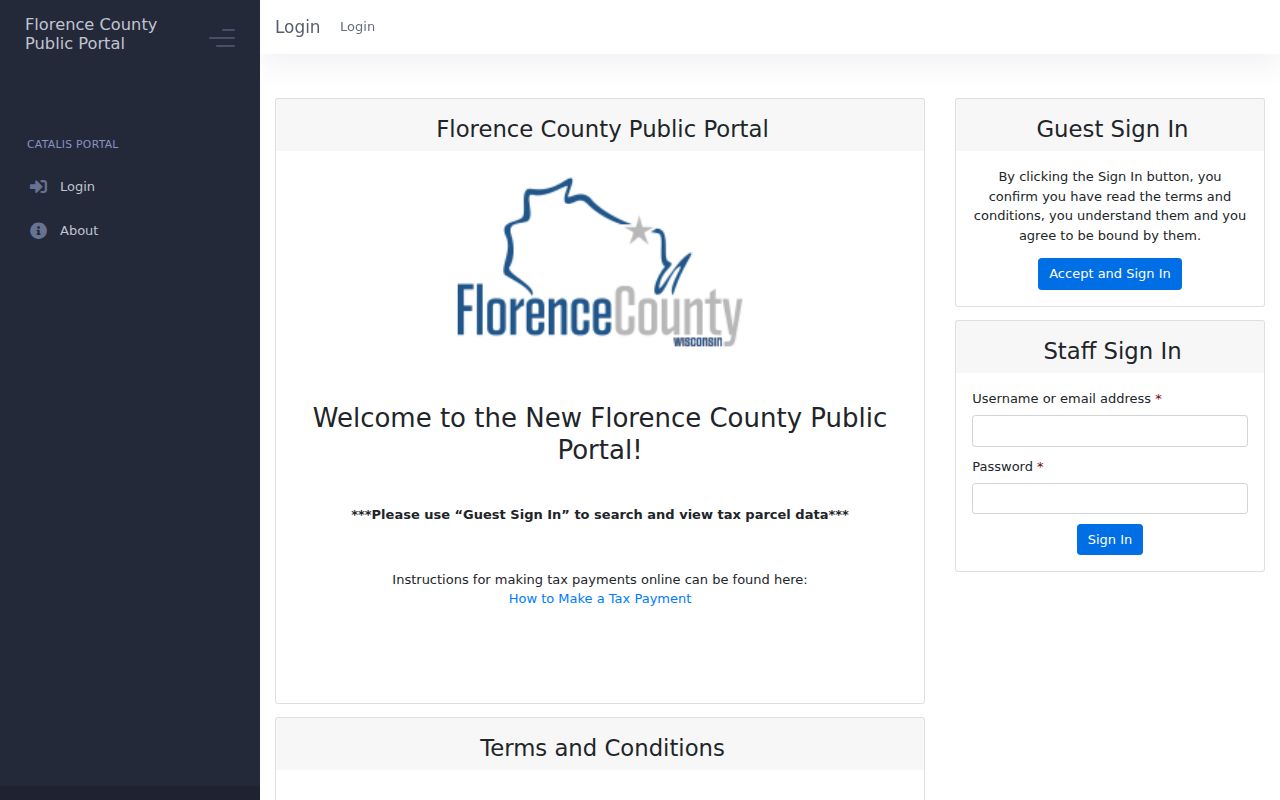
Once inside as a guest, match each result to its parcel number and legal description before trusting an owner or value field. If the public screen does not answer the question, call the Treasurer or the municipal assessor serving the parcel.
Florence County Deed Index Fields
The Register of Deeds name form gives you more than one name box. You can search a grantor, the party transferring an interest. Or search a grantee, the party receiving one. A checkbox covers both roles at once. Standard search sorts by name or date. It strips spaces and punctuation, and it treats leading words like "The" flexibly. Dates run month, day, year. An old deed may name a subdivision or section but no current street address. A separate property description form does the job then.
| Form field | What to enter | Florence search note |
|---|---|---|
| Grantor or grantee | Person or company name | Use the either-role checkbox when direction is uncertain. |
| Entity type | Both, Company, or Human | Trusts, estates, and companies may need a separate pass. |
| Date range | Start and end dates | Optional fields use mm/dd/yyyy. |
| Category or instrument group | Deed, mortgage, plat, lien, release, and related types | Use a narrow category when a broad name search is noisy. |
| Book, page, or file number | Known recording reference | A direct reference can retrieve a known instrument faster. |
| Property description | Subdivision, lot, block, section, map, phase, or unit | Useful when an older description lacks a modern address. |
The Florence County name and instrument search is free to query. The form shows its search fields on its face, so confirm any document number or image link within the system or at the counter.
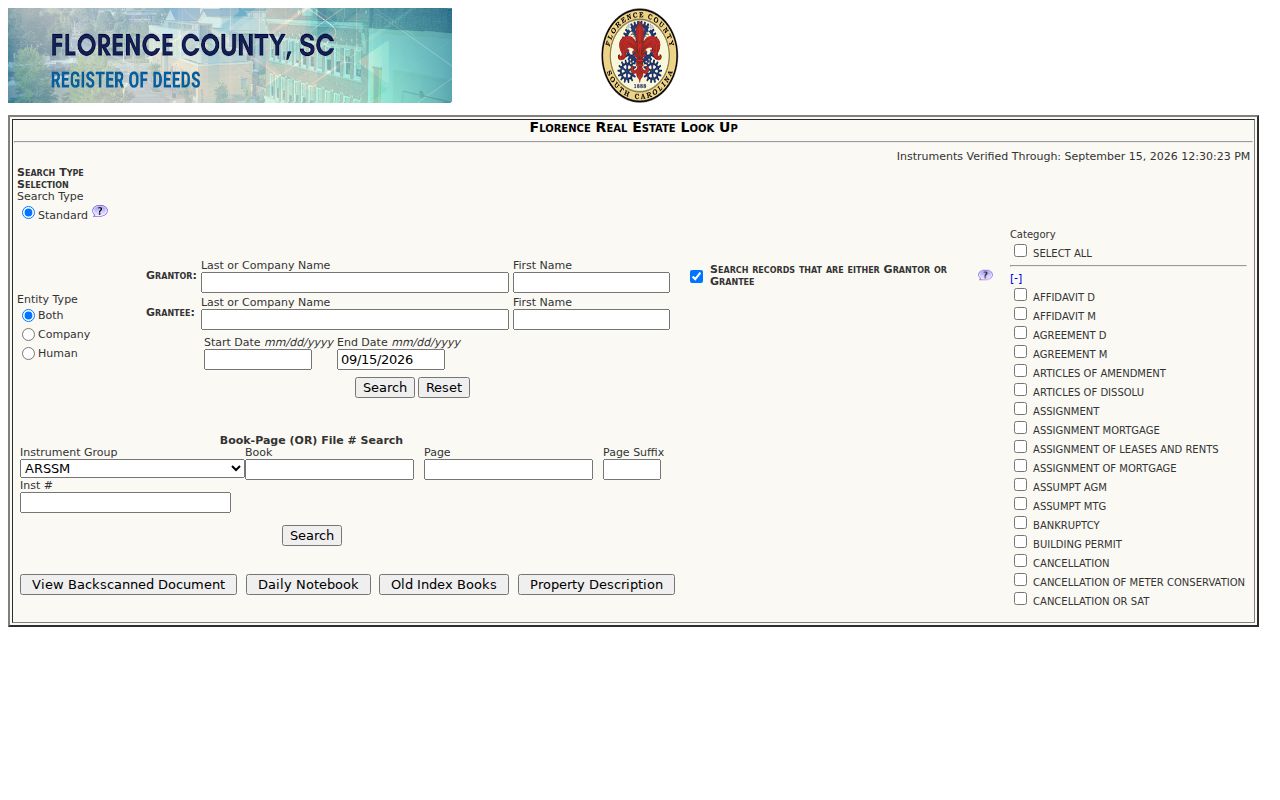
Those distinct fields are why a parcel number or legal description makes a strong second key whenever a name search returns several possible instruments.
The Florence County parcel search result route opens the interactive area where a guest can look up an address or parcel. No guest-session result view is published, so expect to sign in to see the full result layout.
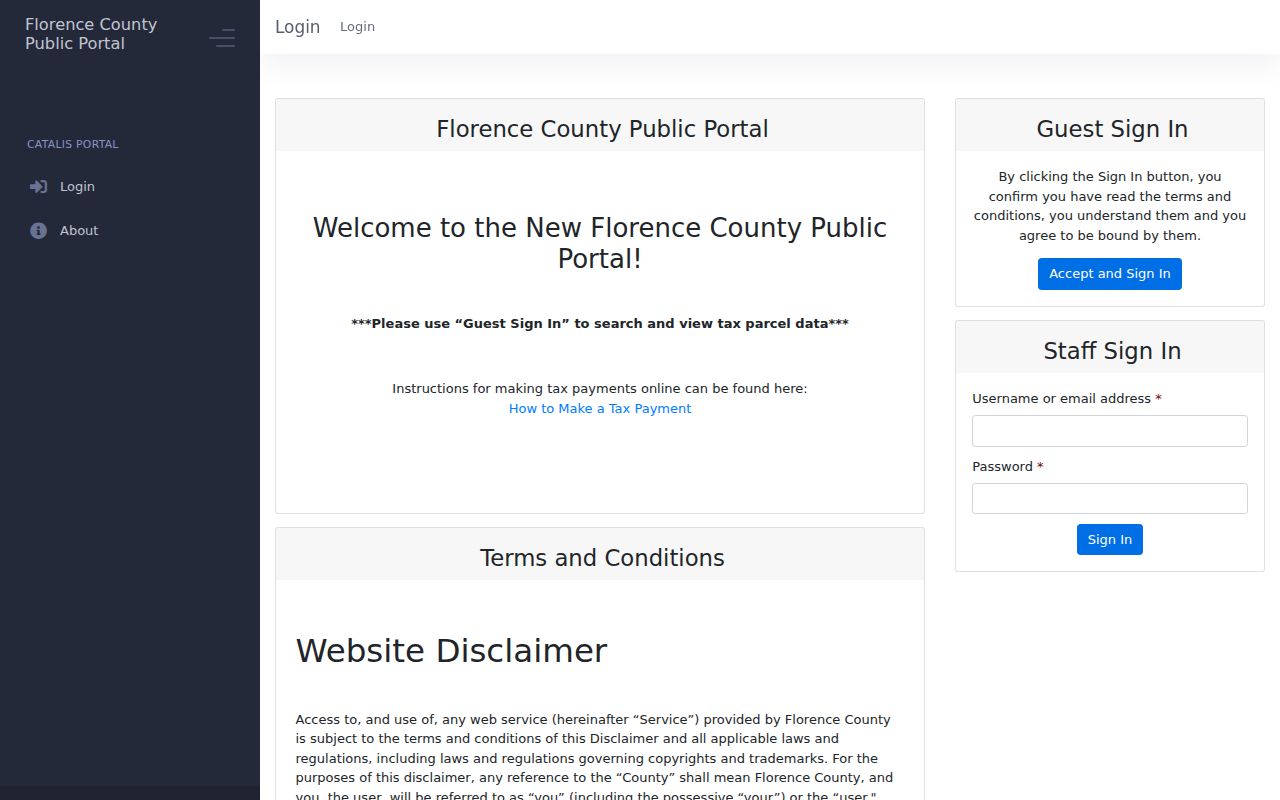
Check the current on-screen labels and tax year before treating any parcel result as a statement of current ownership or value.
Types of Florence County Property Records
Different record sets answer different land questions. The Register of Deeds holds the recorded instrument trail. Tax parcel data and assessment work run through the county portal and the municipal assessors. GIS adds the visual layer. The Planning One Stop keeps permit, inspection, zoning, and code records. Court files can reveal a foreclosure or probate event behind a later instrument, but a court docket never replaces the deed itself.
| Record Type | What It Documents | Kept By | Access |
|---|---|---|---|
| Deeds and conveyances | Transfers and recorded interests in land | Register of Deeds | Free name search; image and counter-copy fees apply. |
| Mortgages, liens, and releases | Recorded claims, assignments, easements, and satisfactions | Register of Deeds | Search by party, category, date, book-page, or description. |
| Tax parcel and assessment | Parcel data, assessment context, owner and mailing clues | County Public Portal and municipal assessor | Guest sign-in for parcel data; ask the assessor about values. |
| GIS and plats | Parcel geometry, mapped context, and historic lot references | Land Information and Wisconsin Historical Society | Public viewer and selected downloadable maps; not a survey. |
| Permits and zoning | Applications, inspections, code cases, and land-use review | Florence County Planning and Zoning | Public search; an account is used for submissions and payments. |
Florence County property records split along clear lines. Deed records answer transfer, mortgage, easement, and release questions, and the instrument image backs up any index entry. For current tax status, the Treasurer's payment route is the right tool. A parcel map orients the search. It cannot settle a line dispute. Permits describe work or review, never title. Wisconsin Circuit Court Access can flag a probate, foreclosure, or quiet-title case, though the official file stays with the Clerk of Circuit Court. Tracing an older owner of record means comparing the modern parcel description with the historical book or plat, since an address is not an unchanging key.
Florence County Tax Roll and Value Clues
Florence County's Public Portal landing page sends visitors to Guest Sign In. From there it opens tax parcel data. A single parcel result can tie together an owner name, mailing address, site address, and parcel number. It can add assessment context as well. Exact labels must be confirmed in the live guest search. Municipal assessors hold the assessment authority. The county Treasurer also serves as Property Lister and Land Information Officer. The Treasurer's portal handles real-estate tax payments too. That split matters when a number needs explaining. Payment status belongs with the Treasurer. How a parcel value was set is a question for the municipal assessor.
State numbers add context. Wisconsin DOR's 2025 report put the Florence County equalized-value increase at 17.84%. Equalized value is a countywide comparison measure certified by the state. It is not a value assigned to each house. It is not an offer price either. DOR bases its statewide measure on market and new-construction data. A parcel's assessed value, a tax bill, and a sale price answer different questions. The right report depends on the question.
Florence County GIS and Parcel Lines
Florence County's Land Information page lists map views, database views, simple queries, pan and zoom, and reporting functions. It points to a public Colligo project and the Wisconsin Statewide Parcel Map. Start with the local viewer for Florence parcel context. Statewide data may draw on a 2025 tax roll even when county records run newer. The statewide download suits broader data work. It is no substitute for a local assessment or a legal survey.
The Florence County GIS and Land Information page warns that its map is not a survey, a title guarantee, or an official boundary determination. The map data can be out of date. It can also carry compilation error. The page directs users to Land Information for original or official determinations. A licensed surveyor settles a legal boundary question.
Florence County Permits and E-911 Addresses
Florence County's One Stop portal bundles permit searches, applications, inspections, payments, complaints, code-enforcement tracking, advanced search, and open data. Public search needs no account. An account supports submissions, payment, and tracking. The application catalog covers building, addition, zoning, floodplain, land disturbance, summary plat, electrical, mechanical, and many other project types. A summary-plat file helps when a parcel was split or created. A permit points to a project. It does not establish who owns the land.
E-911 addressing comes early in the county comprehensive plan. The department checks or assigns an emergency site address before a building permit. That matters where a route name, lake name, mailing town, and legal description do not line up neatly. If a permit search fails, the help page says to use the full address, including city, state, ZIP, and unit. Contact the One Stop Shop if it stays unresolved. For town-level detail, see the Town of Florence property records page.
Florence County Delinquent-Tax Route
Florence County handles unpaid real-estate taxes through an in-rem foreclosure process. The taxes must be at least three years delinquent. The county starts the process in January. It is usually done by November. Once the county becomes the legal owner, the parcel moves to Forestry and Parks. It is sold at a later county land sale. That route is distinct from an ordinary tax payment, a private mortgage foreclosure, or a sheriff sale. A delinquent balance by itself does not mean a property is listed for sale.
For payment details, check the Treasurer's tax portal, whether the balance is current or delinquent. Then check the county land-sales page and the Forestry and Parks notices for county-owned parcels. A search of the deed index should cover tax liens, deeds of distribution, foreclosure satisfactions, and releases. If a case has reached court, WCCA shows the docket. The Clerk of Court can supply a file copy. Before drawing any conclusion about ownership, confirm the final conveyance in the Register of Deeds.
Florence County's 1915 Land Map
The 1915 Hixson plat book predates modern parcel numbering. The Wisconsin Historical Society has digitized the atlas. It includes a Florence County outline map naming landowners. It also has companion Town of Florence and Town of Homestead plates. Treat the pages as a historical layer. They trace old landholding and township context, not current parcel boundaries. A legal description on a recorded deed still bridges that old map and today's tract.
The Wisconsin Historical Society's 1915 Florence County map record carries the map and its atlas metadata. Older books and vault work through the Register of Deeds genealogy route require an appointment. The Florence County Historical Society Museum holds photographs dating to the 1880s. Seasonal hours are posted by the county. Those collections round out house and land history. Deeds still govern the parcel. The recording office remains the source for the legal instrument.
Florence County Court and Estate Changes to Land
Recorded ownership can change through a probate order. It can also change through a personal-representative deed, a foreclosure, or another court event. Wisconsin Circuit Court Access helps find a public Florence/Forest circuit case. The Clerk of Circuit Court keeps the official file. A docket entry is only a lead. It is not the instrument that updates the land record. Match any order or judgment against a later deed, deed of distribution, or release. The Register of Deeds records that instrument.
Keep four things together in a case search. Party name, county, case type, and date range. Confirm a public docket exists. The Clerk of Court can explain access and flag sealed or restricted material. From there, tie the court event to a tax parcel and legal description. Do not assume a lawsuit alone changed the owner of record.
This pays off when an estate, personal representative, lender, or county appears in a deed sequence. Search the instrument category too. Check the parties on both sides of the recorded transfer. Names matter. The Florence County owner research guide explains how to compare names and parcel records. It covers comparisons across those sources.
Limits of Florence County Property Records
Florence County property records show what was assessed, mapped, recorded, paid, or reviewed by an office. They prove no title. A parcel line may never have been surveyed. An assessed value is not a sale price. The Register of Deeds notes that instruments in process may lag online. The Public Portal publishes no confirmed refresh schedule. Treat any search result as a starting point; an official copy and direct confirmation settle conflicts.
Lawful use. Public records support property research, purchase due diligence, and civic review. Do not use owner information to stalk, harass, threaten, or target anyone; a record search also does not replace a title company or licensed surveyor.